The Sangha welcomed Chan Teacher Rebecca Li on Monday, December 1, 2025
She offered a guided meditation followed by a Dharma talk that deepened our understanding of Buddhist ethics. Her teaching focused on the precepts of Non-Harming and Not-Stealing. This talk built upon our recent second-hour discussions as part of the Integrated Dharma Program’s Living with Integrity series.
We hope you found the meditation and the teaching helpful and consider a donation (donna) to the Buddhist Sangha of Bucks County.
Introduction and Guided Body Scan Meditation
In the first part of her talk, Rebecca explores the Buddhist precepts as an essential part of the Eightfold Path, emphasizing that they are not rigid rules but living supports for practice rooted in wisdom and compassion. She explains how upholding precepts—especially refraining from killing—helps protect the mind by working with habits of aversion and hatred, much like meditation methods help us notice when we have wandered. She explains how precepts work alongside meditation and wisdom, helping us notice when we have drifted into unhelpful habits of reactivity, aversion, and forgetting the practice in daily life. Rebecca also discusses how precepts can be practiced at different depths according to one’s causes and conditions, using vegetarianism as an example of a compassionate but optional extension of the precept. Throughout, she highlights that precepts are personal guardrails meant to reduce suffering, not tools for self-righteousness or judging others. Listen to the full talk to explore how the precepts open into wisdom, clarity, and true freedom.
In the second part of her talk, Rebecca continues her exploration of the Buddhist precepts as living practices rather than rigid moral rules, showing how they function as trainings that work directly with the mind. She introduces the Four Proper Exertions to emphasize that ethical practice is not only about refraining from harm, but also about noticing unwholesome states early, allowing them to dissolve, and actively cultivating wholesome qualities such as loving-kindness and care. Through examples drawn from everyday relationships, protecting wildlife, and responding to emergencies, she highlights the importance of balancing compassion with wisdom—clear awareness of the whole situation and our own causes and conditions—so that good intentions do not unintentionally create more suffering.
Rebecca invites listeners to reflect: When hatred or righteousness arises in the name of a “good cause,” are we truly acting in accordance with wisdom and compassion? How do we protect life and act ethically without falling into judgment or self-righteousness? She also deepens the precept of refraining from stealing, reframing it as not taking what is not given or more than our fair share—whether material goods, opportunities, or credit—and shows how this practice helps us recognize and work skillfully with greed.
Drawing on teachings from her teacher, Master Hsuan-Yen, Rebecca further explores desire by distinguishing between genuine needs and excessive wants. She explains that cultivating moment-to-moment awareness allows us to discern when it is appropriate to pursue what we have rightfully earned and when craving or ego-driven desire leads to harm. In this way, ethical practice is revealed not as suppressing desire or becoming passive, but as acting wisely, compassionately, and without attachment to outcomes—supporting a life of greater clarity, integrity, and freedom.
After listening to the talk, you may want to dive deeper into this topic. Rebecca speaks about the essential role of the precepts and how they function as ethical guardrails that support our practice. The infographic below offers a helpful way to understand how they work on the Buddhist path.
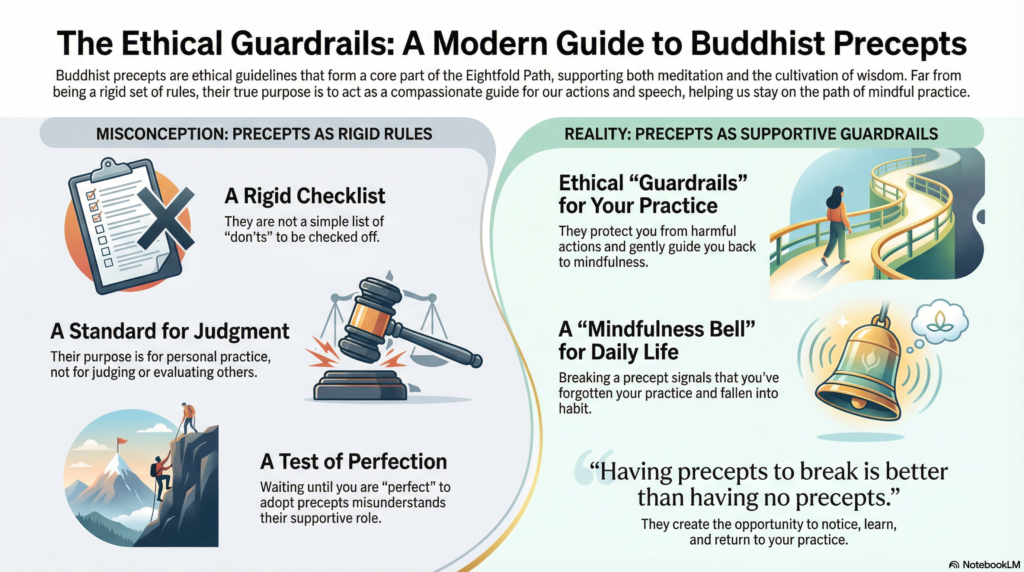
Precepts as Ethical Guardrails on the Path
The Buddhist path is traditionally described as three interdependent trainings: upholding precepts, developing concentration (samadhi), and cultivating wisdom (prajñā). These are not optional components but mutually supportive practices. Precepts, in particular, guide our actions and speech so they remain aligned with wisdom and compassion.
What “Right” Really Means
In the Eightfold Path, “right” action, speech, and thought do not mean morally superior or based on personal opinion. “Right” refers to what accords with wisdom and compassion. From this perspective, precepts are not arbitrary rules but practical reminders to reduce harm and cultivate benefit.
How the Precepts Support Practice
Ethical Guardrails
Precepts help keep our actions and speech aligned with the path. When we stray, they gently point us back rather than punish us.
Supports for Awareness
Just as the breath helps us notice when the mind wanders in meditation, precepts help us recognize when we have forgotten our practice in daily life. Breaking a precept is a signal to return to mindfulness, not a cause for self-blame.
Protection from Harm
Precepts are safeguards against truly harmful actions. Remembering them can interrupt long-held patterns of anger or greed before they lead to irreversible consequences.
Rooted in Wisdom and Compassion
Upholding precepts protects the mind and nurtures compassion. Actions driven by hatred, aversion, or craving are never in accordance with wisdom.
Working at the Root
Violations of precepts usually arise from accumulated mental habits such as greed or aversion. Practicing restraint helps us recognize and loosen these patterns, reducing suffering at its source.
Avoiding Extremes in Practice
While the basic precept against killing refers to human life, some practitioners extend it to animals or insects as a way of deepening compassion. This often raises questions about vegetarianism. Choosing not to eat meat is optional and can be understood as an act of renunciation, undertaken when conditions allow.
At the same time, wisdom cautions against dogmatism or self-righteousness. Precepts are for our own practice, not tools for judging others. Setting standards that exceed our current capacity can create stress and aversion, undermining compassion itself.
Precepts, Desire, and Wise Action
Precepts also help clarify our relationship with desire. The practice is not about suppressing all wants, but about discerning between genuine needs and excessive cravings. Simplified living often reveals how little we actually need, while extreme asceticism can become unskillful.
It is appropriate to accept compensation, recognition, or rewards earned through honest effort—this is not greed. What matters is intention. Using manipulation or entitlement to get what we want contradicts the spirit of the precepts. With clear awareness, we can pursue what is appropriate, let go of what is not, and act in ways that benefit rather than harm.
Precepts are not about moral policing or rigid rules. They are living practices—ethical guardrails that protect us, strengthen awareness, and cultivate compassion. By upholding them, we support meditation and wisdom, allowing ethical conduct, clarity, and care for others to grow together.
Ultimately, the precepts are for our own freedom and well-being. They invite us, again and again, to return to a life guided by wisdom and compassion.
If you missed Rebecca previous visit, please see Dr. Rebecca Li May 2025 Meditation and Dharma talk🌸 Karunā (Compassion) where she talks about how to apply the teachings to everyday life.
About Dr. Rebecca Li, PhD 
Dr. Rebecca Li is a dedicated Chan Buddhist teacher and lineage holder in the tradition of Master Sheng Yen, founder of Dharma Drum Mountain. She is the founder and guiding teacher of the Chan Dharma Community. Her journey began in 1995 when she started practicing and took refuge with Master Sheng Yen. In 1999, after moving to New Jersey, she began serving as his translator and started training as a Dharma and meditation instructor. Following Master Sheng Yen’s passing, she continued her training with Drs. John Crook and Simon Child, her current teacher, and has co-led intensive Chan retreats with Simon while working with the Western Chan Fellowship in the U.K.
She teaches meditation, Dharma classes, and leads retreats at the Chan Meditation Center and Dharma Drum Retreat Center and has been assisting Simon Child in intensive retreats since 2012. Alongside her husband, David Slaymaker, who is also a teacher that has visited our sangha. She leads Chan practice at Rutgers University and the New Jersey chapter of DDMBA and teaches in various community settings in the NJ-NY area. She also serves on the board of the Dharma Drum Retreat Center and is a sociology professor at The College of New Jersey.
Visit her website for more Rebecca Li (智燈法傳 Wisdom Lamp, Dharma Transmitting) – Chan Lineage of Master Sheng Yen Dharma Meditation Zen Retreat Schedule Mindfulness Practice
The Chan Meditation Center: http://www.chancenter.org/
The Dharma Drum Retreat Center: http://www.dharmadrumretreat.org/
See Rebecca’s talk about why we meditate here https://www.youtube.com/watch?v=NZrcxVnufyw
Hear her recording from other visits /tag/rebecca-li/