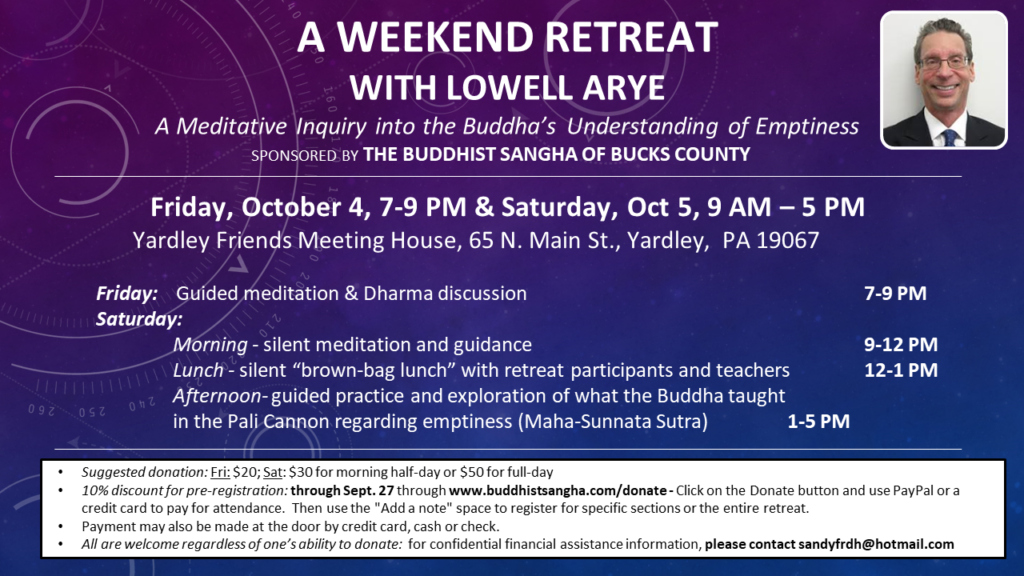
Join us Friday evening Oct 4th (7-9pm) and Saturday Oct 5th (9-5pm) for “A meditative inquiry into the Buddha’s understanding of emptiness. Lowell Arye Will lead the retreat. Friday evening will be a quiet night where we will be cultivating the boundless states of heart of Loving kindness and equanimity. Moira Kowalczyk will provide light guidance during this practice period. Saturday will include periods of meditation held in the space of silence including the lunch hour. The afternoon Will continue with guided practice and an exploration of what the Buddha said in the Pali Canon about emptiness (Maha sunnata sutta) Light refreshments will be available and a brown bag lunch is recommended. It is best to attend the entire retreat, however we please come to any portion if unable to attend the entire retreat .
****unfortunately Padmadharini will not be co-leading due to unforeseen events . Lowell Arye will be leading the full day Saturday
Schedule for BSBC Day Retreat
9:00-9:15 Get
Settled, a few points about the day
9:15-9:45 Meditation
9:45-10 Break
10-10:45 Meditation
10:45-11 Break
11-11:45 Meditation
11:45-1 Lunch
1-1:45 Meditation
1:45-2 Break
2-2:45 Meditation
2:45-3 Break
3-3:45 Meditation
3:45-4:15 Break
4:15-4:45 Meditation
4:45-5 Discussion
About Lowell
Lowell Arye has been diligently practicing the Path of the Buddha for 17 plus years. He is an avid and committed retreatant completing many retreats both with Sanghas and in solitary in traditions of Vipassana (insight), Zen/Chan, Mahamudra and Dzogchen. Influential teachers from Tibetan Buddhist traditions include Garchen Rinpoche, Namkai Norbu, Chokyi Nyima Rinpoche, and Francis Lucille and Rupert Spira from the Advaita Vedanta /Kashmiri Shavism tradition of Jean Klein.
There is a suggested donation of $20 for Friday, $30 for Sat. am session and $50 for all day Saturday. All are welcome despite ability to donate.
Posted inHome|TaggedHome, meditation retreats, retreat|Comments Off on October 2019 Retreat – A Meditative Inquiry into the Buddha’s Understanding of Emptiness
Thai forest monk Thanissaro Bhikkhu teaches us how to use wisdom to cultivate compassion
The fourth principle [of karma] to remember concerns the karma you’re creating right now in reaction to other people’s pleasure and pain. If you’re resentful of somebody else’s happiness, someday when you get happy there’s going to be somebody resentful of yours. Do you want that? Or if you’re hard-hearted toward somebody who’s suffering right now, someday you may face the same sort of suffering. Do you want people to be hard-hearted toward you? Always remember that your reactions are a form of karma, so be mindful to create the kind of karma that gives the results you’d like to see.
When you think in these ways, you see that it really is in your interest to develop the brahma-viharas in all situations. So the question is, how do you do that? This is where another aspect of the Buddha’s teachings on causality plays a role: his teaching on fabrication, or the way you shape your experience.
Fabrication is of three kinds: bodily, verbal, and mental. Bodily fabrication is the way you breathe. Verbal fabrications are thoughts and mental comments on things—your internal speech. In Pali, these thoughts and comments are called vitakka—directed thought, and vicara, evaluation. Mental fabrications are perceptions and feelings: the mental labels you apply to things, and the feelings of pleasure, pain, or neither pleasure nor pain you feel about them.
Any desire or emotion is made up of these three types of fabrication. It starts with thoughts and perceptions, and then it gets into your body through the way you breathe. This is why emotions seem so real, so insistent, so genuinely “you.”
But as the Buddha points out, you identify with these things because you fabricate them in ignorance: you don’t know what you’re doing, and you suffer as a result. But if you can fabricate your emotions with knowledge, they can form a path to the end of suffering. And the breath is a good place to start.
If, for example, you’re feeling anger toward someone, ask yourself, “How am I breathing right now? How can I change the way I breathe so that my body can feel more comfortable?” Anger often engenders a sense of discomfort in the body, and you feel you’ve got to get rid of it. The common ways of getting rid of it are two, and they’re both unskillful: either you bottle it up, or you try to get it out of your system by letting it out in your words and deeds.
So the Buddha provides a third, more skillful alternative: Breathe through your discomfort and dissolve it away. Let the breath create physical feelings of ease and fullness, and allow those feelings to saturate your whole body. This physical ease helps put the mind at ease as well. When you’re operating from a sense of ease, it’s easier to fabricate skillful perceptions as you evaluate your response to the issue with which you’re faced.
Here the analogy of the lump of salt is an important perception to keep in mind, as it reminds you to perceive the situation in terms of your need for your own goodwill to protect yourself from bad karma. Part of this protection is to look for the good points of the person you’re angry at. … If you focus just on the bad points of other people, … you’ll get bitter about the human race and see no need to treat it well. But if you can see the good in other people, you’ll find it easier to treat them skillfully. Their good points are like water for your heart. You need to focus on them to nourish your own goodness now and in the future.
If, however, the person you’re angry about has no good qualities at all, then the Buddha recommends another perception: Think of that person as a sick stranger you’ve found on the side of the road, far away from any help. You have to feel compassion for him and do whatever you can to get him to the safety of skillful thoughts, words, and deeds.
What you’ve done here is to use skillful verbal fabrication— thinking about and evaluating the breath—to turn the breath into a skillful bodily fabrication. This in turn creates a healthy mental fabrication—the feeling of ease—that makes it easier to mentally fabricate perceptions that can deconstruct your unskillful reaction and construct a skillful emotion in its place. This is how we use our knowledge of karma and fabrication to shape our emotions in the direction we want— which is why head teachings are needed even in matters of the heart. At the same time, because we’ve sensitized ourselves to the role that the breath plays in shaping emotion, we can make a genuine change in how we physically feel about these matters. We’re not playing make believe. Our change of heart becomes fully embodied, genuinely felt.
This helps to undercut the feeling of hypocrisy that can sometimes envelop the practice of the brahma-viharas. Instead of denying our original feelings of anger or distress in any given situation, smothering them with a mass of cotton candy or marshmallow cream, we actually get more closely in touch with them and learn to skillfully reshape them.
All too often we think that getting in touch with our emotions is a means of tapping into who we really are—that we’ve been divorced from our true nature, and that by getting back in touch with our emotions we’ll reconnect with our true identity. But your emotions are not your true nature; they’re just as fabricated as anything else.
Because [your emotions] are fabricated, the real issue is to learn how to fabricate them skillfully, so they don’t lead to trouble and can instead lead to a trustworthy happiness.
Remember that emotions cause you to act. They’re paths leading to good or bad karma. When you see them as paths, you can transform them into a path you can trust. As you learn how to deconstruct emotions of ill will, hard-heartedness, resentment, and distress, and reconstruct the brahma-viharas in their place, you don’t simply attain an unlimited heart. You gain practice in mastering the processes of fabrication. As the Buddha says, that mastery leads first to strong and blissful states of concentration. From there it can fabricate all the factors of the path leading to the goal of all the Buddha’s teachings, whether for head or for heart: the total happiness of nirvana, unconditionally true.
Which simply goes to show that if you get your head and your heart to respect each other, they can take each other far. Your heart needs the help of your head to generate and act on more skillful emotions. Your head needs your heart to remind you that what’s really important in life is putting an end to suffering. When they learn how to work together, they can make your human mind into an unlimited brahma-mind. And more: They can master the causes of happiness to the point where they transcend themselves, touching an uncaused dimension that the head can’t encompass, and a happiness so true that the heart has no further need for desire.
At our first discussion, we will be reading and considering part of an article by Thanissaro Bhikku on how the Four Brahma-Viharas relate to aspects of Karma, so we will get to explore together parts of what Karma means, as well. Click to read the first part of the article that we will read together
Waking Up Waking up this morning, I smile. Twenty-four brand new hours are before me. I vow to live fully in each moment and to look at all beings with the eyes of compassion.
Brushing Your Teeth Brushing my teeth and rinsing my mouth, I vow to speak purely and lovingly. When my mouth is fragrant with right speech, a flower blooms in the garden of my heart.
Walking Meditation The mind can go in a thousand directions. But on this beautiful path, I walk in peace. With each step, a gentle wind blows. With each step, a flower blooms.
Watering the Plants Don’t think that you are cut off, dear plant. This water comes to you from the Earth and sky You and I have been together since beginningless time.
Smiling at Your Anger Breathing in, I know anger makes me ugly, Breathing out, I do not want to be controlled by anger. Breathing in, I know I must take care of myself, Breathing out, I know loving kindness is the only answer.
Sitting Meditation Breathing in, I know I am breathing in. (In) Breathing out, I know I am breathing out. (Out) Breathing in, I feel my breath becoming deep. (Deep) Breathing out, I feel my breath becoming slow. (Slow) Breathing in, I calm my body and my mind. (Calm) Breathing out, my body and my mind are at ease. (Ease) Breathing in, I smile. (Smile) Breathing out, I release all tension in my body and mind. (Release) Breathing in, I dwell in the present moment. (Present Moment) Breathing out, I know this is a wonderful moment. (Wonderful Moment)
Driving a Car Before starting the car I know where I am going. The car and I are one. If the car goes fast, I go fast.
Washing the Dishes Washing the dishes is like bathing a baby Buddha. The profane is the sacred. Everyday mind is Buddha’s mind.
Talking on the Telephone Words can travel thousands of miles. May my words create mutual understanding and love. May they be as beautiful as gems, as lovely as flowers.
Sitting or Walking Meditation I have arrived, I am home In the here, In the now. I am solid, I am free. In the ultimate I dwell.
Drinking Tea This cup of tea in my two hands, mindfulness held perfectly. My mind and body dwell in the very here and now. Laying in Bed Resting in the ultimate dimension, using snowy mountains as a pillow and beautiful pink clouds as blankets. Nothing is lacking.
Notice how pedaling the exercise bike
starts the display & when you stop, it turns off after a few seconds?
Similarly
meditation powers up your mindfulness muscle so you enjoy the benefits throughout
the day. When you stop returning to the practice it stops working just like the
exercise bike …
Meditation practice is very important – it allows Direct
Access to the present moment (this moment is the only moment you have now) All
the benefits of meditation stem from practice coming back to this moment
There are many meditation
techniques / mind trainings out there – you may find yourself “shopping around”
and that’s fine – just pick one that appeals to you and practice diligently –
but resist the urge to give up on the method in luau of other methods you hear
and read about. Really give it a good heartfelt try (4-6 weeks at least) – try
to deepen your practice with it.
We have several simple methods on our
website buddhistsangha.com/how-to-meditate
and at our library at 65 N Main Street Yardley PA –Join us Monday evenings 7pm -9pm – more info is at buddhistsangha.com website
We also
publish links and other places to visit in our area buddhistsangha.com/links
We are pleased that Dr. Rebecca Li will be with us again on Monday, April 29, for guided meditation and teachings.
Rebecca will explore with us the topic “Why do we practice? Why do we sit?” With these questions in mind, we will probe our own motivations for practice, what we might expect from our practice, and what the path of practice means to us.
Why do YOU practice?
Please consider asking yourself this question, and be ready to share and learn that night.
Dr. Rebecca Li, a Dharma heir in the Dharma Drum lineage of Chan Master Sheng Yen, started practicing meditation in 1995. She began her teacher’s training with Master Sheng Yen in 1999 to become a Dharma and meditation instructor. Later on, she trained with John Crook and Simon Child to lead intensive retreats and received full Dharma transmission from Simon Child in 2016. Currently, she leads Chan retreats, teaches meditation and Dharma classes, and gives public lectures in North America and the U.K. Her talks and writings can be found at www.rebeccali.org. She is the founder and guiding teacher of Chan Dharma Community and a sociology professor at The College of New Jersey, where she also serves as faculty director of the Alan Dawley Center for the Study of Social Justice.
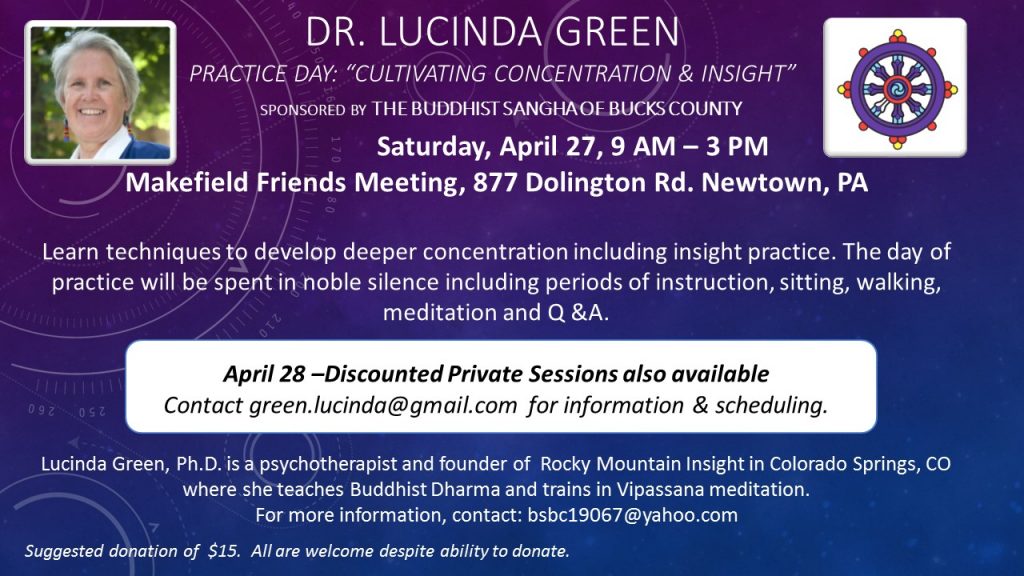
Lucinda Green, Ph.D. will lead Meditation Retreat in Bucks County on “CULTIVATING CONCENTRATION & INSIGHT” in a historic Quaker meetinghouse in Bucks County, Pennsylvania – The Buddhist Sangha of Bucks County, a community open to all levels of interest in meditation and Buddhism, will be sponsoring a one day retreat on Saturday, April 27th, 2019 from 9 AM-3 PM at the Makefield Friends Meeting House located at 877 Dolington Road in Newtown, PA.
The weekend meditation retreat theme will be “CULTIVATING CONCENTRATION & INSIGHT” Learn techniques to develop deeper concentration including insight practice. The day of practice will be spent in noble silence including periods of instruction, sitting, walking, meditation and Q &A. The day will proceed with a combination of silence, Meditation, instruction and direct experience. There is a suggested donation of $15. All are welcome despite ability to donate. For those wishing to delve deeper with Lucinda, private sessions will be available on the following day, April 28. The sessions will be at a tranquil private setting nearby in historic home situated on 80 acres with walking paths and bench lined streams available for contemplative integration. Contact: green.lucinda@gmail.com for information & scheduling.
If you want to get a glimpse of Lucinda Green in action be
sure to attend the Buddhist Sangha at the Yardley Friends Meetinghouse for a
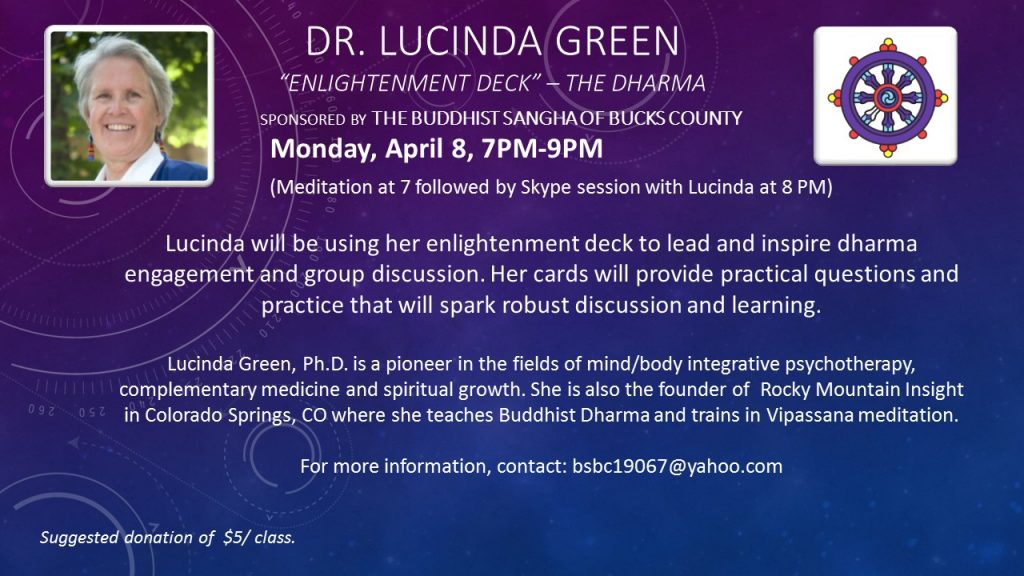
Skype presentation featuring Dr. Green on Monday, April 8th. She
will focus on her “Enlightenment Deck” to lead and inspire Dharma
engagement and group discussion. The 80 card deck provides brief
explanations of Buddhist terms accessible to anyone as well as delightful
corresponding images. Meditation will begin at 7pm. Presentation will start at
8 p.m.
Lucinda
Green, Ph.D. is a psychotherapist and founder of Rocky
Mountain Insight in Colorado Springs, Colorado where she teaches
Buddhist Dharma and trains in Vipassana meditation. She is a pioneer in the
fields of mind/body integrative psychotherapy, complementary medicine and
spiritual growth. For more information,
contact: bsbc19067@yahoo.com
About Buddhist Sangha of Bucks County
The Buddhist Sangha of Bucks County is a community (sangha) that practices Buddhism, provides meditation instruction and community service in a manner consistent with the teachings of the Buddha. The Sangha is open to everyone who wishes to learn about meditation and/or Buddhism. To learn more, please visit www.buddhistsangha.com or contact: bsbc19067@yahoo.com
Posted inHome|TaggedHome, Lucinda Green, retreat, visiting teacher|Comments Off on Lucinda Green, Ph.D. will lead Meditation Retreat in Bucks County on “CULTIVATING CONCENTRATION & INSIGHT” 4/27/19
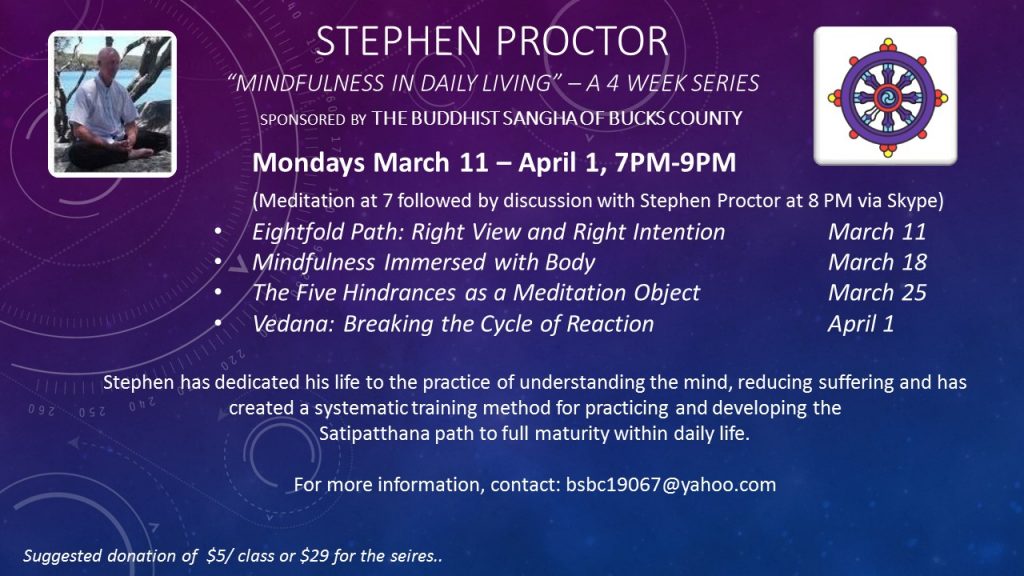
March / April Stephen Proctor Mindfulness in Daily Living (MIDL) will be joining us via Skype to teach a 4 week series:
3/11 Eightfold Path: Right View and Right Intention. 3/18 Mindfulness Immersed within Body. 3/25 The Five Hindrances as a Meditation Object. 4/1 Vedana: Breaking the Cycle of Reaction.
Stephen has dedicated his life to the practice of understanding the mind, reducing suffering and had created a systematic training method for practicing and developing the Satipatthana path to full maturity within daily life. http://www.meditationintheshire.com.au/
Join us Monday 2/4 7-9 with visiting teacher Singhashri as we cultivate deeper states of absorption through mindfulness of breathing, opening the heart and inviting in the resultant fruits including joy, integrity, peace and contentment
A teacher with the Triranta Buddhist Community, second generation American currently living in the UK. Read more about her and read/listen to her teachings https://www.radicalembrace.org
From Singhashri’s website: “Any radical act must get down to the root of things, which often lies below the surface, is hidden from view, taken for granted, yet is ultimately essential for existence. The radical embrace calls us to face and draw in near, as near as we can get, the very crux of the matter, the rub of our existence. We may have spent our whole life, up until now, running from our pain, ignoring our vulnerability, hiding from our own shadow. The radical embrace is about waking up, not only to the shadow, but to the deep, transformative power inherent there.”
You may send a check to 65 North Main Street in Yardley, PA 19067 (Att:BSBC) or if you prefer, you may donate online via PayPal by clicking on the Donate button