The BSBC New Year’s Eve Retreat

On this last evening of the year, you are invited to join the BSBC community for a rare and lovely opportunity to engage in extended meditation practice with our sangha. The retreat begins at 8 pm and end at 12 am.  Everyone is welcome to come for the whole or part of the evening. The schedule will include guided meditation instructions, chanting, alternating sitting and walking meditation periods, and a time for sharing poems, readings and reflections. Visiting Sangha member and long-time practitioner Jeanne Reis is coming down from Boston with BSBC founder James, and has graciously agreed to lead the New Year’s Eve Retreat meditation sessions, as she has for the past couple years. Tea with light refreshments will be offered at 9:30 pm.

If you aren’t able to arrive at 8 pm, you may either time your arrival to coincide with a walking session or enter quietly if the group is sitting. If a sitting is in progress, choose a spot in the back of the hall, then feel free move to a preferred spot during the next walking session. There will be chanting sessions at the beginning and end of the evening; chanting sheets will be provided.

You may bring a favorite poem, reading, and snack to share at teatime, if you wish.

Suggested donation is $10 to cover the cost of reserving the meetinghouse

Please contact us with questions 

Evening Schedule:

8:00 – 8:20 pm                      Welcome & chanting
8:20 – 9:00 pm                      Guided sitting meditation
9:00 – 9:30 pm                      Walking session* (instructions available)
9:30 – 10:15 pm                    Sharing readings, poems, intentions over tea
10:15 – 10:45 pm                  Mindful Movement
10:45 – 11:15 pm                  Quiet sitting
11:15 – 11:30 pm                  Walking session*
11:30 – 12:00 am                  Sitting & closing chant

*You may opt to continue sitting during walking sessions, if you wish
On the first Monday of every month, we offer Meditation instruction for the first 20 minutes of our meeting to anyone who is new to the sangha or just wants to brush up on their meditation technique.  This is a great opportunity to bring in your family and/or friends to check out the sangha and try out meditation.

Posted in Home | Tagged , , | Comments Off on The BSBC New Year’s Eve Retreat

Starting out with intention

The following post appeared in Bucks Co. Courier Times
written by Edna Telep

Sometimes the universe sends its messages ‘loud and clear’, and often, they come from intentionthe most unlikely sources. I think I was blessed with just such messages a few weeks ago. With Thanksgiving behind me, I awoke on the following Monday worrying about two responsibilities I had to fulfill within the week: getting my weather-damaged Christmas display repaired and mounted and writing this column. I faced them both with dread. It wasn’t that they were so inherently difficult in themselves, but the holiday season often puts me into a glassy-eyed, nearly frantic state, making any job that comes up during that period seem all the more insurmountable. In addition, as a perfectionist, responsibilities usually weigh heavily on me, and I could feel tension starting to settle into my chest.

As luck would have it, my daughter called early in the morning to tell me about her experience with her bird feeder. Apparently it had been noticed by many colorful birds, and then by hordes of sparrows. She was distraught because the numerous sparrows were monopolizing the feeder and emptying it every day, leaving nothing for the other varieties of birds. She wanted to discourage the sparrows but still keep the feeder full for other birds, so she continued to fill it but prayed for a solution. A few days later, she spotted a Sharp-Skinned Hawk, uncommon in her area, nearby. This hawk is known to prey on sparrows, and my daughter was relieved that her problem had been solved without her having to take any offensive action against them.

Later in the day, I went to my Tai Chi class. Although Tai Chi has martial arts applications, my class stresses the health and flexibility benefits of the art, not the aggressive applications. However, Clyde, our teacher, often mentions the protective uses of some of the movements. A main principle of Tai Chi is non-aggression and victory by using one’s opponent’s aggression as a force against him. Clyde used the phrase, “soft overcomes hard”, which seemed to me to be the same message I got from my daughter’s story.

Both of these incidents put me in mind of the value and wisdom of spiritual teachings about non aggression, turning the other cheek, and having right intention. If our intention is to have love and compassion for all beings rather than to have our immediate needs satisfied, the universe will sometimes supply the vehicle to make things work out as we wish them to. Buddhism lists Right Intention as one of the steps on its Noble Eightfold Path, the path leading us out of human suffering; other spiritual traditions teach similar principles. If our intention is to do no harm, we need to examine our attitudes and motivations before we act, especially if our action is of a retaliatory nature, and realize that it’s in our own highest interest to be less ego-invested. Learning to ask ourselves if what we want serves the highest good for all is a worthwhile habit to acquire. Buddhism asks us to develop an unselfish view of the world because we are all interconnected, and our fates are ultimately intertwined, a fact easily confirmed by reading the headlines in any newspaper.

The universe was looking out for me on that Monday. My sweet and artistically talented daughter offered to help me to repair my Christmas display, relieving my mind of one major worry. As a bonus, her bird feeder story suggested a theme for this column.

Posted in Home | Tagged , , | Comments Off on Starting out with intention

Zen Teacher Visits Sangha

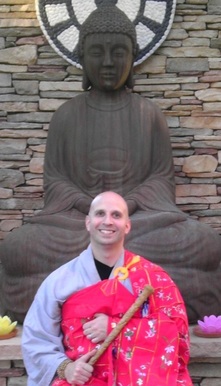
On November 23rd, Andre Doshim Halaw, who is a Zen monk in Princeton and teacher in the Five Mountain Zen Order visited our sangha and gave the following Dharma Talk.

PictureAndre teaches high school English and online courses at Buddha Dharma University, where he is also completing his doctoral degree in Buddhist Studies. Andre practiced for several years in two Japanese lineages, Harada-Yasutani and Soto, before finding his home in the Korean Five Mountain Zen Order.

In November 2012, Andre received inka (independent teaching authorization) from his teacher Zen Master Wonji Dharma.

You can visit Andre at his Zen blog, Original Mind or follow him on Twitter.

Click for more audio recordings

Posted in Home | Tagged , , , | Comments Off on Zen Teacher Visits Sangha

Eating Mindfully

Mindful EatingEating is such a significant part of our daily lives, yet it’s so easy to disconnect from it. In one moment, our plates are full, and in the next, completely empty. What happened? We hardly tasted or consciously enjoyed even one bite.

We can change this mechanical way of eating by establishing a daily mindful eating practice.

Set aside a few minutes each day to practice mindful eating. Start with committing to eating one meal or snack mindfully each day. It’s helpful to begin with a small amount of one type of food that is not a trigger food for overeating. Begin by picking up and holding the piece of food, such as a grape, in your hand. Allow your senses to become alive: smell the grape, notice its contours, shape, colors, how it feels in your palm, between your fingers. When the mind wanders to thoughts of the past or future, gently bring it back to the grape. There is no other grape like it in the universe. Then, mindfully lift your hand and place the grape in your mouth.

Continue Reading


Posted in Home | Tagged , , | Comments Off on Eating Mindfully

Annual Report 2015

The Mission of the Buddhist Sangha of Bucks County is: To Present, Teach and Practice Buddhism, and to Provide Meditation Instruction and Community Service in a Manner Consistent with the Teaching of the Buddha.

Be a lamp unto yourselves, be a refuge to yourselves, do not turn to external refuge, hold fast to the Truth as a lamp, hold fast to the Truth as a refuge.  (The Buddha, Digha Nikaya, XVI, 2.26)

The purpose of our Sangha is to serve as a place for us to explore what such a truth might look like, feel like, and mean for each of us. During the past year, the BSBC has explored a variety of sources of Buddha’s teachings. Working together, we have offered real resources to all who have joined us through meditation practice, dharma discussions, and opportunities for compassionate service. We have studied the Buddha’s teachings and related practices and traditions through visiting teachers, the book group hosted by board member Edna Telep, and weekly discussions. We have continued to explore Shantideva’s poem “A GUIDE TO THE BODHISATTVA’S WAY OF LIFE,” with the able assistance of John Wenz, and return frequently to the fundamentals of meditation.

lama gursam retreat

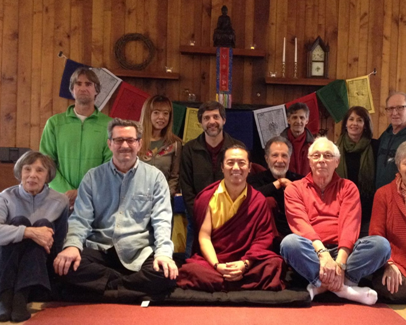
We also were blessed to have visits in the spring and fall from our Tibetan teacher, and special friend, Lama Gursam, which included both dharma talks and one-day retreats. We deepened our relationship with the Princeton Buddhist Meditation Group through visits by Beverly Sanford and her teacher, Ani Trime. A number of Sangha members attended teachings by Anam Thubten, the spiritual director of the Dharmata Foundation, and as well as a retreat and classes offered by the Princeton group.

Our meditation period was strengthened by new members leading the service, and energized by additional Pali chants led by vice-president, Dave Mermelstein, who also assisted me throughout the year in organizing and leading our discussion period, with increased attendance at both.

We began to have more frequent contact with the Buddhist Sangha of South Jersey through the active participation of new Sangha member, David Clark, who helped export our August Gratefulness Challenge month to include their members. In September, the Sangha organized a field trip to the Bucks County Aikido Dojo, where we practiced Zazen together, witnessed an intense Aikido body arts session, and had a Q & A session with Sensei George Lyons.

The BSBC bylaws, which govern us as a non-profit service organization, were updated by the board to reflect more accurately how we operate. Three new standing committees were added to the bylaws to create a clearer structure: Program, Outreach, and Communications.

JimOf special note this year, we held a thank-you and goodbye party for Jim Hild, who moved to the Cape Cod area this summer.  Jim joined the Sangha early in its life; served as President, Vice-President, and Treasurer at different points; was a great support to our founder James Reis; and rarely missed a Monday night service. I am personally grateful for his assistance in mentoring me before he left. We’re glad he has already been back to visit and is always welcome!

This year we have added to our Sangha service and discussion amenities by reorganizing our storage area, thanks to the work of board members Lou Procaccino and Gil Howard. Also, our shrine area has a new look, thanks to ideas and work of Lou and board members Rika Barrett and Susan Harrison.

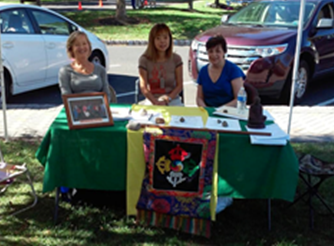
We have continued our outreach and service activities through contributions to the Bucks County protective shelter, and through board member Marilynn Picciotti’s efforts, have reached out to assist homeless persons on the street in nearby communities.  We continued our commitment to participate in the development of the Family Promise program, which will work with the homeless and low-income families to achieve sustainable independence. And we have continued to participate in Pennsylvania’s road outreachclean-up program, collecting trash along our designated highway in Levittown, PA, organized by Rika.  We made others aware of our presence by having tables at two community events, the annual Yardley Friends arts and crafts market and at the Button Park Peace Fair in Yardley.

We brought awareness of Buddhist teachings through four invited columns in the Bucks County Courier Times, From a Faith Perspective, written by board member and Treasurer, Edna Telep, and myself.

We are grateful to board members Susan Harrison and Eugene Pevzner for continuing to upgrade our communications and social media presence, which include a more informative weekly BSBC e-newsletter listing coming events and special short articles, an enhanced website, and Facebook page.  One result of their efforts is shown by the approximately 80 newcomers who have attended Monday night services this year. Louise Wile, our Librarian, has updated our lending library that provides many Buddhist books, periodicals, DVDs, tapes, and audio books.

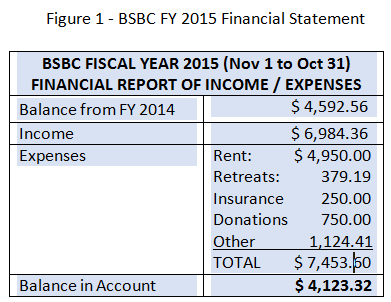
Financially we ended the year (Nov 2015) with a balance of $4,123.32 as seen in Figure 1.  These expenses included $4,950 for our rent for the year based on $90 per Monday evening and special events at the Meeting House.

2015 expenses

We look to the coming year to continue the growth of our Sangha, experiencing mindfulness, and welcoming speakers to further our understanding of Buddhist teachings while supporting the practice of our members and visitors. All are truly welcome.

I am grateful for the opportunity to be of service to the BSBC, which has added depth, meaning, as well as interesting and surprising people to my life.

– Phil Brown, President


Posted in Home | Tagged , | Comments Off on Annual Report 2015

The Five Skandhas

Dave Mermelstein presented this teaching in November 2015

The Five Skandhas: Heaps? Aggregates? How about “Rivers of experience?”

The skandhas can be thought of as the  components that come together to make an individual, a sense of self, an “I” or “me”.

Everything that we think of as “I” is a function of the skandhas. Put another way, we might think of an individual as a process of the skandhas.

The component parts of the skandhas work together so seamlessly that they create the sense of a single self, or an “I.” But the Buddha taught that there is no “self” occupying the skandhas. Understanding the skandhas is helpful to seeing through the illusion of self.

They are:

  1. Form or matter/ something that can be sensed
  2. Feeling / Sensation
  3. Perception/ recognition
  4. Mental formations/ thought/ volition/ free will
  5. Consciousness/ awareness
  1. Form – or matter; something material that can be sensed.

    The Five Sense Organs & The Five Corresponding objects:

  1. Eye                             Visible Forms
  2. Ear                              Sounds
  3. Nose                           Smells [chemical compounds]
  4. Tongue                       Tastes
  5. Body                           Tangible things [touch, inner-body]

 Additionally, we should include the inner-body feelings of hunger and thirst, and feeling satiated or having our thirst quenched. Furthermore, we should consider the feelings of being ill, and of being deeply relaxed.

  1. Feeling or Sensation- Vedana–is the physical or mental sensation that we experience through contact of the six faculties with the external world. It is the sensation experienced through the contact of eye with visible form, ear with sound, nose with odor, tongue with taste, body with tangible things, and mind with ideas or thoughts.

Although this is called the skandha of feelings, it does not mean emotional feelings, but something more like sensations. These are said to be the painful, pleasant and neutral sensations in the body and the in the mind.

We are always experiencing sensations, mostly neutral ones, but also painful and pleasant. They can also be thought of as the sensations that occur based on sense impressions. A sense object such as incense would belong under the skandha of form, but the sensation created when we smell it belongs in this category of feelings. And this could be pleasant or unpleasant, depending on whether you like or dislike that incense.

According to the teachings, feelings are important because they are the basis for attachment and aversion.

  1. Perception – is the capacity to conceptualize and recognize things by associating them with other things. For example, we recognize shoes as shoes because we associate them with our previous experience with shoes.

It’s important to realize that this is not the bare perception of a thing, but the recognition of it. So, not the chemical process taking place on the tongue between the sodium atom and the taste receptor, but the recognition of that contact as “salty.”

Perception means the apprehension of a specific object, as distinct from something else. On the conceptual level, this means the recognition of identities or names, and on the sensory level it means the discernment of the five objects of sense. Technically, perception is defined as ‘that which grasps or identifies characteristics’. Perception could be non-conceptual, in the case ofthe five physical senses, or conceptual, as in the perception of thoughts and ideas.

  1. Mental Formations/ Objects of Mind– Thoughts and emotions. Volition, or will. Action, agency.

The category called Formations is a little complicated. But if we limit ourselves to mental formations, then it basically refers to thoughts and emotions, or what are technically referred to as the ‘mental states’. Biases and prejudices belong to this skandha, as do interests and attractions. Cultivated, meditative mind states such as calm, loving-kindness, equanimity, and compassion also fit within this skandha.

All volitional actions, good and bad, are included in the skandha of mental formations. But– how are actions “mental” formations? Our mental states cause us to act.

Remember the first lines of the Dhammapada:

We are what we think- all that we are arises with our thoughts… Speak or act with an impure mind and trouble will follow you… Speak or act with a pure mind and happiness will follow you…

The skandha of mental formations is associated with karma, because volitional acts create karma, just as mind states express intentions, which then lead to action. So emotional states cause us to act in certain ways, and those actions cause or affect our karma.

5. Consciousness/ awareness

Consciousness here refers to the awareness of impressions from the five senses, and also consciousness of mental objects, like thoughts, ideas and emotions. The consciousnesses of the five senses (seeing, hearing, smelling, tasting, and touching) are non-conceptual (“when hearing, there is only hearing”). This consciousness is where there is a receiving, a holding, of sense data. Visual consciousness registers only colors and shapes. It does not recognize particular colors, which is the function of the skandha of perception. Nor does it identify certain colors as pleasant, which is done by the skandha of feeling.

It is important to understand that consciousness depends on the other skandhas and does not exist independently from them. It is an awareness but not a recognition, as recognition is a function of the third skandha. This awareness is not sensation, which is the second skandha. For most of us, this is a different way to think about consciousness, since we usually think of it as the chugging along of our mental processes.

It is also important to remember that consciousness is not “special” or “above” the other skandhas. It is not the “self.” It is the action and interaction of all five skandhas that create the illusion of a permanent, separate self.

____________________________________

We can learn to see all of these as streams of experience, always occurring, that all together create our sense of self. So when we get familiar with these, we can, at any time, stop and ask ourselves: What is making this experience of Me right now? What streams of experience are happening right now, that make me feel this sense of “I”, of “me”?

And just as we say that we can stand on line at the grocery store and engage in mindful breathing meditation, or that we can stand in Mountain Pose while we are waiting at the bank, so too can we engage in the investigation of “what makes me feel that I am a separate self right now?” by exploring these elements of being, these skandhas, at any time.

It can become an active investigation, and we can know this teaching experientially, with our whole being.

Sources include:  An Introduction to the Aggregates by Barbara O’Brien; About.com, Guide to the Five Skandhas; www.rigpawiki.org; and Guy Armstrong’s dharma talk on the subject, 10-02-15 at Spirit Rock Meditation Center.

Download the The Five Skandhas

Posted in Home | Tagged , | Comments Off on The Five Skandhas

An excerpt from Daily Life is Practice, by Sylvia Boorstein, in Shambhala Sun, July 2015

All the moments of your day are teachings. If you look at them clearly, you’ll see the same fundamental truths the Buddha did.

Think back to the image of the Buddha. Under siege from external events and his internal responses, he preserved his peace of mind with alert steadiness and unshakeable goodwill. Following his enlightenment, the training path the he prescribed for developing those capacities is a summary of lifestyle choices and mind training that we can undertake as well. It is called the eightfold path of practices:

Wise Action, wise speech and wise livelihood specifically pertain to being engaged in the world. The Buddha is said to have counseled his son, Rahula, “Before (or during or after) doing or saying anything, you should consider if what you just said or did is good for yourself as well as good for everyone else.”

All our actions, even our choice of livelihood, should meet the criteria of kind intent. Committing to that intent involves wise mindfulness, the precision in the mind to notice the motives that precede actions, and wise concentration, the steadiness in the mind that makes it less likely to become confused.

Wise effort is the resolve, at every choice-point, word, or deed, to discern and choose wholesome actions. Wise understanding is our deepening conviction that peace of mind, and the natural goodwill and compassion that grows from it, depends on wholesome choices. Wise intention is our ever-renewing dedication to all the practices that promote these wholesome choices.

Beginning dharma students often ask me, “How will I take this practice out into the world?” I say that it is important to set aside some time every day to sit quietly, or have a quiet walk, specifically to encourage the mind to relax. Just taking “time off”, in whatever healthful way works for you and your schedule, removes the uncomfortable sense of imperative that is likely to arise in a day crowded with tasks. The main thing I want to share, though, is this:

Daily life is practice. Because life in the world is as complex as it is, it is the optimal setting for developing the capacity of equanimity and the habit of benevolence. The techniques that we learn in classes and retreats are techniques for living life.

The Buddha began his spiritual quest hoping to discover the answer to the suffering of regular people. He did and we are the beneficiaries of his example. For now we know that we too can wake up to the unconscious habits of our minds and transform them, through wisdom, into compassion.

Posted in Home | Tagged | Comments Off on An excerpt from Daily Life is Practice, by Sylvia Boorstein, in Shambhala Sun, July 2015

Narayan Liebenson evening chants in Pali

Narayan Liebenson leads two chants in Pali – Enjoy!

Click for more audio

Posted in Home | Tagged , , | Comments Off on Narayan Liebenson evening chants in Pali

Gratitude Challenge

gratitude-journalThis article appeared in the Bucks County Courier Times, August 21, 2015
Buddhists issue ‘gratitude challenge’
by Philip Brown

One of the aims of spiritual life from a Buddhist perspective is to awaken a sense of joy in our existence. This joyfulness feels wonderful to us personally, and it can also serve to help us develop a benevolent and compassionate heart, in spite of the difficulties of everyday life.
A way to enhance our feeling of joyfulness comes through a deep acknowledgment of all that we have for which we are grateful. As Jack Kornfield, a prominent Buddhist teacher puts it, “Gratitude is a gracious acknowledgment of all that sustains us, a bow to our blessings, great and small, an appreciation of the moments of good fortune that sustain our life every day. Gratitude is confidence in life itself. It is not sentimental, not jealous, nor judgmental. Gratitude does not envy or compare. Gratitude receives in wonder the myriad offerings of the rain and the earth, the care that supports every single life” (from his book, The Art of Forgiveness, Lovingkindness, and Peace).

One of the psychologists who has studied gratitude defines it in two parts. First, it must include an affirmation of goodness, that there are good thing in the world, gifts and benefits we’ve received. We need to identify something outside ourselves that we are grateful for. Second, it must include identifying the source of this goodness, where it comes from. For example, if I affirm I am grateful for the fresh ear of summer corn I am having for dinner, I need to consider and think about all the people it took to put that ear in my hands: the seed producer, the farmer who planted and grew it, the folks who made the combine harvester, the trucker who brought it to the store. We can think even more deeply and appreciate the soil, sun and water without which the corn could not have grown.

There have been a number studies that document many benefits of practicing gratitude. For example, at the physical level scientists report stronger immune systems, lower blood pressure, and better sleep for people who regularly engage in gratitude practice. At the psychological level, people report experiencing more positive emotions such as joy and pleasure, and being more optimistic and happy. Gratefulness also contributes to being more outgoing, forgiving, helpful to others, generous and compassionate.
In the process of being grateful we acknowledge that other people or planet earth, or God, if you are a believer in the divine, has given us many gifts, big and small, to help us achieve the goodness in our lives. Gratitude has the added benefit of helping to reduce or block negative emotions, such as envy, resentment and regret, and helping us celebrate the present.

The gratitude challenge: This month the Buddhist Sangha of Bucks County has challenged its members and anyone who wants to try it, to a gratitude challenge. Each morning, note down three things for which you are grateful. The directions are simple –
First, think of something you are grateful for – use the definition above for guidance; remember, this is not about yourself (not, I am grateful for how smart I am), but about what you have received from others. Second, write it down. In the act of writing, both the object and reason for your choice become more concrete, and other aspects of what and why you are grateful are often revealed. Third, spend at least 15-20 seconds meditating on each entry before moving on to the next; consider it fully, emotionally and engage your heart. That’s it! The research shows that doing this consistently over a period of 6-8 weeks is already enough to start enjoying some of the benefits noted above.
We are grateful that the Courier Times has made this opportunity available to us to share this practice with you, and invite you to consider joining us in establishing your own gratitude practice!

Phil Brown is president of the Buddhist Sangha of Bucks County. From a Faith Perspective is a weekly column written by members of Lower Bucks faith communities.

Posted in Home | Tagged , , | Comments Off on Gratitude Challenge

About the love of the universe and giving up our story

Buddhist Compliment

Tonight we listened to a portion of a talk by Reggie Ray about giving up ‘our story’ and the freedom that comes from letting go.

We pondered what or who would you be without your story? We looked at how a story you make up is just a shortcut into a way of being that is completely made up and keeps you safe.  It’s scary to think about that since who are you without you?

Also there was another point, about letting the deep love of the universe be known to us at the deepest level.

“We humans are born for joy. Born for bliss. Born for freedom. What we are doing here is the ordinary human thing, and it is very old, and it has been covered over by society. We have to do the work. We have to remove the blinders from our hearts.”

What’s alluded to here is that the words can not properly describe what this ‘love of the universe’ really means or what is meant by emptiness. We can only point to it, but ultimately “you” have to do the work.

The talk we listened to was part of this talk : Episode 121: Born for Joy.

Other podcasts are available on this page


Posted in Home | Tagged , , | Comments Off on About the love of the universe and giving up our story