A Personal Perspective on Meditation

By Jim Hild From Reflections Magazine

Our bylaws state our mission– “To Present, Teach and Practice Buddhism: To Provide Meditation Instruction and Community Service in a Manner Consistent with the Teaching of the Buddha.” Since I became a member of the Buddhist Sangha of Bucks County (BSBC) in the year 2001, our Sangha has been purposely non-traditional, exploring many of the Buddhist valuable and wonderful traditions over the years. To a large degree we have followed our mission.

We have over the years presented and taught many subjects, including meditation. It has become clear to me just how important meditation is to Buddhism and me over the last few years. I thought I might share a personal perspective on this subject.

Having pletting goersonally explored the major Buddhist traditions, I am currently caught between two traditions – Zen and Tibetan. I have found significant value in both of these traditions as well as other traditions Theravadan, Won and others. I have found all of these traditions, numerous schools, and individual approaches exist for the “practice of meditation”, that is to say, meditation is not only common to all, but significant in its meaning and importance. However, in my somewhat limited experience, while I have found remarkable agreement among them as to what is the meaning and value of the meditative process, I have found differences in how to do it or what is involved in the process.

I have learned that a distinctive Buddhist orientation towards meditation can be summed up concisely. It consists of two aspects or components. The first, called shamatha in Sanskrit, is the step by step development of mental and physical calmness. The Zen tradition for example emphasizes this approach. My teacher, Jeff Shore (Rinzai Zen master and professor of Zen in the Modern World at Hanazono University in Kyoto) consistently tells me to meditate by “calming the senses”. The second, vipashyana, Sanskrit,( vipassan ā, Pali) is the step by step heightening of awareness, sensitivity and observation. The latter is currently being elegantly addressed by Jeanne Reis in her “The Four Foundations series”. Thank you Jeanne! I have found that these two components can complement each other and can be practiced separately or simultaneously – one technique develops calming, while the other develops clarity. I have learned (but not mastered) to employ both equally.

I have been told that shamatha, if taken to an extreme, leads to special trance states; these may be of value, but they are not the ultimate intention of Buddhism. Jeff emphasizes “letting go” and just observing what happens. To me this is when awareness or a “one-pointedness” or concentration comes into play. I attempt to establish direct contact with deep processes. One approach is to be given a question which can be readily answered by the deep spontaneous mind but is utterly intractable for the discursive surface. This approach was developed within certain schools of the Chan-Zen tradition, that important East Asian expression of Buddhism. Nowadays, it is particularly associated with Rinzai-shu, one of the two major schools of Japanese Zen. Such a conundrum is called a koan in Japanese; “What is the sound of one hand?” and “Mu” are two famous one’s. The koan question is mercilessly pressed to deeper and deeper levels, and, in the process, great samadhi power is developed. When an answer wells up, it carries with it a valuable insight. In this way, by answering many such koans, the wisdom faculty is gradually exercised. However, if the question is pressed deeply enough, the insight accompanying its solution will be sufficient to crack moha and bring kensho (initial enlightenment). It is important to remember, however, that there are many kinds of koans for specific purposes and that individual teachers use koans in different ways.

The practice of vipashyana or clear observation, on the other hand, if developed with sufficient intensity and consistency leads to a moment of insight into the nature of the self identification process. At that moment, awareness penetrates into the normally unconscious chain of mental events which gives us the rock-solid conviction “I am separate and limited.” This insight brings with it a radical and permanent change in perspective . . . a refreshing sense of freedom which is not dependent upon circumstances. The attainment of this perspective and the full manifestation of its implications in daily life are the intention of Buddhist meditation.

I guess what it comes down to is to be open and clear in one’s intentions during meditation. There are many paths for entering the reality of Nirvana, but in essence they are all most likely contained with two practices: stopping and seeing. It has been said “Stopping is the primary gate for overcoming the bonds of compulsiveness. Seeing is the essential requisite for ending confusion.” May we all benefit from our meditation.Jim

Posted in Home | Tagged | Comments Off on A Personal Perspective on Meditation

Wisdom of Impermanence: What is Anicca?

Wisdom of Impermanence: What is Anicca?”
Discussion led  by Marc Kaye, Communications Committee

“Not Always So”

from a talk by Gil Fronsdal, 2001, Insight Meditation Center

www.insightmeditationcenter.org/books-articles/articles/impermanence

Insight into impermanence is central to Buddhist practice.

The Buddhas last words were: All conditioned things are impermanent. Strive on with diligence.

Many religions grapple with impermanence and suffering. Some spiritual traditions equate the world of impermanence with suffering. For these, the solution to suffering is to transcend the world of impermanence.

The Buddha approached suffering differently. He said that suffering is not inherent in the world of impermanence; suffering arises when we cling. When clinging disappears, impermanence no longer gives rise to suffering. The solution to suffering, then, is to end clinging, not to try to escape from the transient world.

One means of reducing clinging is to see the transient nature of what we cling to. This insight can either show us the futility of trying to find lasting happiness in what is impermanent, or it can encourage us to examine deeply why we cling.

Impermanence can be understood in three ways. First, is the obvious, ordinary understanding of impermanence. Second, is understanding from insight, from the intuitive, direct seeing of the nature of things. Finally, there is the way in which seeing impermanence can lead to liberation.

Beyond the ordinary experience of impermanence, Buddhist practice helps us open to the less immediately perceptible realm of impermanence, i.e., insight into the moment-to-moment arising and passing of every perceivable experience. With deep concentrated mindfulness, we see everything as constantly in flux, even experiences that ordinarily seem persistent.

As we see impermanence clearly, we see that there is nothing real that we can actually cling to. Our deep-seated tendency to grasp is challenged, and so may begin to relax. We see that our experiences don’t correspond to our fixed categories, ideas, or images. We realize that reality is more fluid than any of our ideas about it. Suzuki Roshisummarized Buddhist understanding as: “Not always so.”

Confronting impermanence profoundly, in this meditative way, can open us to liberation. The final, liberativelevel of impermanence is the movement towards letting go at the deepest level of our psyche. AjahnChahonce said, “If you let go a little, you’ll have a little peace. If you let go a lot you’ll have a lot of peace. If you let go completely, you’ll have complete peace.” This release is sometimes called Mahasukha, the Great Happiness, which is said to be the only happiness that is ultimately reliable.

Thanks to Impermanence, Everything is Possible” –ThichNhatHanh-

“Anicca(Impermanence) Holds the Key”

from “A World of Impermance: The Three Marks”, Doug Smith

http://secularbuddhism.org/2015/01/05/a-world-of-impermanence-the-three-marks

Impermanence causes suffering.It is not simply that there are these two marks of existence, aniccaand dukkha, but rather that aniccabrings about dukkhawhen the world is regarded with ignorance, or to say it differently in the absence of wisdom.

So we see that for the Buddha, although there are three stated marks or characteristics of existence, anicca, dukkha, and anatta, when looked at carefully they appear to reduce more or less to a single, key characteristic: that of impermanence or anicca. The other two derive from that basic feature of reality, when wisdom is absent.

In a sense the entirety of Buddhist philosophy and metaphysics can be seen as a lengthy coming to terms with the truth of impermanence. This isn’t surprising, since if we think about it impermanence is the only of the three characteristics that is mind-independent, that would be present in the universe were there no conscious beings. Without conscious beings there would be no dukkha, and there would be no locus around which anotion of self could coalesce. There would only be the impermanence of physical form.

This led us to a realization that anicca(impermanence), holds the key, since the other two characteristics of dukkha(unsatisfactoriness) and anatta(non-self) are brought about by impermanence, when in the presence of ignorance.

“Everything is in Flux”

from “The Context of Impermanence”, Andrew Olenzki, 1999,

https://www.bcbsdharma.org/article/the-context-of-impermanence

In the intellectual environment in which Buddhism evolved, the concept of something being stable and lasting was very important.

In the pre-Buddhist Indian world, the word nityawas often used to designate that foundation, that stability. The view put forward in the Upanishads, for example, suggests that within all the changes of the individual being there is a deep part of one’s psyche, called the āmanor the self, that in some way either underlies or transcends…all of the changes that go on moment to moment. If we could only discover this subtle self in our experience and dwell in it moment to moment, we would manage to overcome the transience of the world and become established upon something eternal and everlasting.

This is the background against which Buddhism was working. And the Buddha, with his several excursions into the nature of human experience, basically came to the conclusion that this is an entirely constructed concept. The claim of stability articulated in these traditions is really just an idea that we project onto our world; it is not to be found in actual experience. So one of the principle insights of the whole Buddhist tradition is that the entire world of our experience… is fundamentally not permanent, not unchanging. Everything is in flux.

“Everything vanishes. Practice goes on.”

from “Impermanence is Buddha Nature”, Norman Fischer, Omega Institute

https://www.eomega.org/article/impermanence-is-buddha-nature

As far as classical Buddhism is concerned, impermanence is the number one inescapable, and essentially painful, fact of life. It is the singular existential problem that the whole edifice of Buddhist practice is meant to address. To understand impermanence at the deepest possible level (we all understand it at superficial levels), and to merge with it fully, is the whole of the Buddhist path. The Buddha’s final words express this: Impermanence is inescapable. Everything vanishes. Therefore there is nothing more important than continuing the path with diligence. All other options either deny the problem or give it short shrift.

The happiness that spiritual practice promises is not endless bliss, endless joy, and soaring transcendence. Who would want that in a world in which there is so much injustice, so much tragedy, so much unhappiness, illness, and death? To feel the scourge of impermanence and loss and to appreciate it at the same time profoundly as the beautiful essence of what it means to be at all—this is the deep truth I hear reverberating in the Buddha’s last words. Everything vanishes. Practice goes on.

“Anyone who has lost something they thought was theirs forever finally comes to realisethat nothing really belongs to them.” ―Paulo Coelho

“The butterfly counts not months but moments, and has time enough.” ―Rabindranath Tagore

“I always think everything is going to last forever, but nothing ever does. In fact nothing exists longer than an instant except the thing that we hold in memory” ―Sam Savage

“That which is impermanent attracts compassion. That which is not provides wisdom. (116)” ―Stephen Levine

Small Group Exercise: Choose a quote from below or one of your own & discuss how it relates to your thoughts on Impermance.

“What is true for one time only is truer than what’s always true.” ―Marty Rubin


Posted in Home | Tagged , , , , , , , , , | Comments Off on Wisdom of Impermanence: What is Anicca?

Let silence take you to the core of life

Since Buddha woke up the world to the possibility of enlightenment some 2,500 years ago, his teachings reached far and wide across the continent and the world. At its core is the simple act of meditation.

“Let silence take you to the core of life.”  – A famous mystic and poet Rumi once said

We sit down and take a deep breath, and examine the present moment with awareness and openness and practice coming back to this moment again and again.  How will the silence teach you?  You are invited to find out for yourself.

There are lots of ways to meditate and lots of help available, but one thing is certain – You have to believe it’s important to invest the time to practice.   I wish that you and all people take the time to meditate and journey into the world that Prince Siddhartha (Buddha) discovered.

mind-training

Posted in Home | Tagged , | Comments Off on Let silence take you to the core of life

“Wisdom of Non-self: What is Anatta?”

 “Wisdom of Non-self: What is Anatta?”

Discussion led by Dave Mermelstein, Vice President of The Buddhist Sangha of Bucks County

Below is what may be the most important part of Monday night’s discussion about Not Self— that it’s more skillful to fully understand the question better than any possible answer:

“…The Buddha would answer only questions that provided an answer to our primal question and helped put an end to suffering and stress. Questions that would get in the way, he would put aside, because the problem of stress and suffering is urgent. Usually when we hear the teaching on not-self, we think that it’s an answer to questions like these: “Do I have a self? What am I? Do I exist? Do I not exist?” However, the Buddha listed all of these as unskillful questions. Once, when he was asked point-blank, “Is there a self? Is there no self?” he refused to answer. He said that these questions would get in the way of finding true happiness. So obviously the teaching on not-self was not meant to answer these questions. To understand it, we have to find out which questions it was meant to answer.

Buddha taught us there is no solid self

As the Buddha said, he taught two categorical teachings: two teachings that were true across the board and without exceptions. These two teachings form the framework for everything else he taught. One was the difference between skillful and unskillful action: actions that lead to long-term happiness, and those that lead to long-term suffering. The other was the list of the four noble truths: the truth of suffering, the cause of suffering, the end of suffering, and the path to the end of suffering.

If you want to put an end to suffering and stress, these two categorical teachings carry duties or imperatives. In terms of the first teaching, you want to avoid unskillful action and give rise to skillful action. In terms of the second, the four truths are categories for framing your experience, with each category carrying a specific duty you have to master as a skill. You need to know which of the truths you’re encountering so that you can deal with that truth in the right way. So- Suffering must be comprehended, the cause of suffering must be abandoned, the end of suffering must be realized, and the path to the end of suffering must be developed as a skill.

These are the ultimate skillful actions, which means that the mastery of the path is where the two sets of categorical teachings come together. The path begins with discernment—the factors of right view and right resolve—and discernment begins with this basic question about which actions are really skillful: “What, when I do it, will lead to long-term welfare and happiness?”

From Selves and Not Self, by Thanissaro Bhikkhu

To continue learning about this topic and more, we recommend visiting Access to Insight:

www.accesstoinsight.org

Posted in Home | Tagged , , , , , , , , , , | Comments Off on “Wisdom of Non-self: What is Anatta?”

George Haas Dharma Talk: “The Meaningful Life”

The Buddhist Sangha of Bucks County will be hosting our second “virtual” guest teacher and Mettagroup founder, George Haas, this time you will be able to view it live via YouTube Live on May 15th to discuss “The Meaningful Life” from 8-9PM:

https://www.youtube.com/watch?v=GpZds1vItsM

Please keep in mind that using YouTube Live is an experiment that the Sangha is running, and we apologize in advance for any technical difficulties. The only certain way to be a part of this event is to attend the Sangha on Monday May 15th. Thank you for your understanding.

In support, donations are welcomed and appreciated.

All are welcome!


George Haas

Mettagroup Founder George Haas, and The Meaningful Life.

Mettagroup founder George Haas, who will lead a discussion via Skype at the May 15 meeting of the Buddhist Sangha of Bucks Count (BSBC), began his creative explorations in the fine arts, as a visual artist and poet associated with the late Seventies downtown New York City art scene that coalesced around the iconic Club 57 — a community that included Keith Haring, Jean-Michel Basquiat, and Madonna, among others. (George’s work will be included in a Club 57 retrospective at the Museum of Modern Art opening on October 31).

Following a relocation to Los Angeles to advance a career in the film industry George began to study meditation with Shinzen Young, which led to his pursing the path of meditation teacher and ultimately founding Mettagroup. George has brought his creative and synthetic skills to bear in a skillful wedding of Theravada Buddhist theory and practice and the modalities of western psychology, particularly Attachment Theory, with spectacular results. “George’s teachings are extraordinarily powerful,” says BSBC sangha member Philip Murphy. “Looking through the lens of attachment theory at the ways we form and maintain personal relationships, and utilizing Buddhist meditation practice to reimagine and implement affirming life strategies has had a profound impact on my way of being in the world.” states Philip. (To view a two-minute overview video on Mettagroup’s The Meaningful Life course, click here.)

To view a 2 minute video on Mettagroups “The Meaningful Life” course please visit:

https://vimeo.com/174866097

To learn more:

https://www.mettagroup.org/

https://en.wikipedia.org/wiki/Attachment_theory

http://press.moma.org/2016/11/club-57/


Posted in Home | Tagged , , , , , | Comments Off on George Haas Dharma Talk: “The Meaningful Life”

Wisdom: What is Dukkha? “The Denial of Dukkha”

Wisdom: What is Dukkha? “The Denial of Dukkha”

Dukkha is often translated as Suffering, but this definition tends to create complications for us. It can better be understood as Unsatifactoriness.

“The word dukkha is made up of the prefix du and the root kha. Du means “bad” or “difficult.” Kha means “empty.” “Empty,” here, refers to several things—some specific, others more general. One of the specific meanings refers to the empty axle hole of a wheel. If the axle fits badly into the center hole, we get a very bumpy ride. This is a good analogy for our ride through saṃsāra.” 

~Joseph Goldstein , Mindfulness: A Practical Guide to Awakening


Three Kinds of Suffering

dukkha-dukkha                    the dukkha of physical and mental pain.

viparinama-dukkha            the dukkha of constant change.

[Subtle dukkha related to Anicca.]
Often tied to suffering caused by pleasant experience
ruined by impermanence leaving cravings unsatisfied.

sankhara-dukkha                 the dukkha of life’s compositional nature.

[Subtle dukkha related to Anatta.]
Often tied to suffering caused by unpleasant
experience and taṇhā, or craving.


Struck by Two Arrows

When touched with a feeling of pain, the uninstructed run-of-the-mill person sorrows, grieves, and laments, beats his breast, becomes distraught. So he feels two pains, physical & mental. Just as if they were to shoot a man with an arrow and, right afterward, were to shoot him with another one, so that he would feel the pains of two arrows; in the same way, when touched with a feeling of pain, the uninstructed run-of-the-mill person sorrows, grieves, & laments, beats his breast, becomes distraught. So he feels two pains, physical & mental.”

~ The Buddha, Sallatha Sutta


Three Types of Taṇhā

kama-taṇhā

craving for sense objects which provide pleasant feeling, or craving for sensory pleasures.

bhavana-taṇhā

craving to be something, to unite with an experience. Ego-related in  opposition to Anatta.

vibhana-taṇhā

craving to not experience unpleasant things in the current or future life, such as unpleasant people or situations.


Saṃsāra & The Three Poisons

Raga               greed, sensual attachment (opposite of Dāna).

Dvesha           aversion, ill will (opposite of Mettā).

Moha              delusion, confusion (opposite of Paññā).

The three poisons or the three unwholesome roots in Buddhism, refer to the three root kilesas of Moha (delusion, confusion), Raga (greed, sensual attachment), and Dvesha (aversion, ill will). These three poisons are considered to be three afflictions or character flaws innate in a being, the root of Taṇhā, and thus in part the cause of Dukkha (suffering, pain, unsatisfactoriness) and rebirthsIn the Buddhist teachings, the three poisons (of ignorance, attachment, and aversion) are the primary causes that keep sentient beings trapped in samsara.


What is Right View?

Acceptance of The Four Noble Truths, discerning the difference of mind and matter, an understanding of the cause and effect nature of reality, and clearly seeing into the characteristics of existence gives us insight into the cessation of suffering.


What are Feeling Tones?

Vedana:          (sensation, or feeling)  Sensory experience of an object.
It is either pleasant, unpleasant or neutral.

How can an exploration of Vedana lead to a cessation of The Three Poisons?


GROUP DISCUSSION AND EXERCISE

“So, as soon as I feel a little “off kilter” or dissatisfied, I stop and say: “Ah, this is dukkha.” Then, I trace my experience backwards until I find the place where I’m not getting what I want, or I’m getting what I don’t want: the craving or longing that is tanha. Lastly, I consciously try to let go of this craving – to just accept the circumstances of my life as they are.”

~Toni Bernhard

Allowing yourself to be a little vulnerable, and accepting that all of us suffer, meet with one, or (no more than) two people in a group. Share something in your life (perhaps a thought that comes up in meditation practice) that brings up difficult feelings of anger, sorrow, or fear. Accepting that this is a natural part of what it means to be human, and bringing an awareness to those feelings, explore how The Three Poisons contribute to these feelings. What role does attachment and aversion contribute to these negative feelings? How does an understanding of The Three Marks of Existence soften the blow of this suffering? Without attempting to resolve the problems or feelings right at this moment, consider what it would take to just be present and accept those feelings as they are right now.

Posted in Home | Tagged , , , , , , , , , , , , , , , | Comments Off on Wisdom: What is Dukkha? “The Denial of Dukkha”

2017 Spring Dharma of Trash in June

The Spring Road Clean Up (Dharma of Trash) will be Saturday June 3rd from 1pm until 3pm.  Rain Date is June 10th 1-3pm

Take part in our community service project and enjoy time with Sangha friends. The Buddhist Sangha of Bucks County has been responsible for cleaning this stretch of road for more than 10 years.

We will meet at the Golden Dawn Diner, 7115 New Falls Rd., Levittown, PA 19055. Pick up tools and safety vests are provided, bring some water to drink and a pair of gloves.

Thank you for your participation!

Please sign up here http://www.signupgenius.com/go/10c0e44acaa29a5fd0-spring

Posted in Home | Tagged , | Comments Off on 2017 Spring Dharma of Trash in June

Wisdom discussions in May 2017

The BSBC will be discussing Wisdom each Monday in May after 7pm meditation period.

The aspect of Wisdom in our practice is the parami of Panna. How is wisdom different from knowledge? Emptiness and The Three Characteristics fall under this Wisdom category of the Paramis.

The Three Marks of Existence
(The Three Characteristics of all Conditioned Things)
Impermanence     (Anicca)
Suffering               (Dukkha)
Not-Self                (Anatta)

What does it mean that all conditioned things are marked by these three characteristics, and how can this help us on our path of understanding?

Please join us these nights as we explore these important teachings of the Buddha.

Posted in Home | Tagged , , , , , , , , , | Comments Off on Wisdom discussions in May 2017

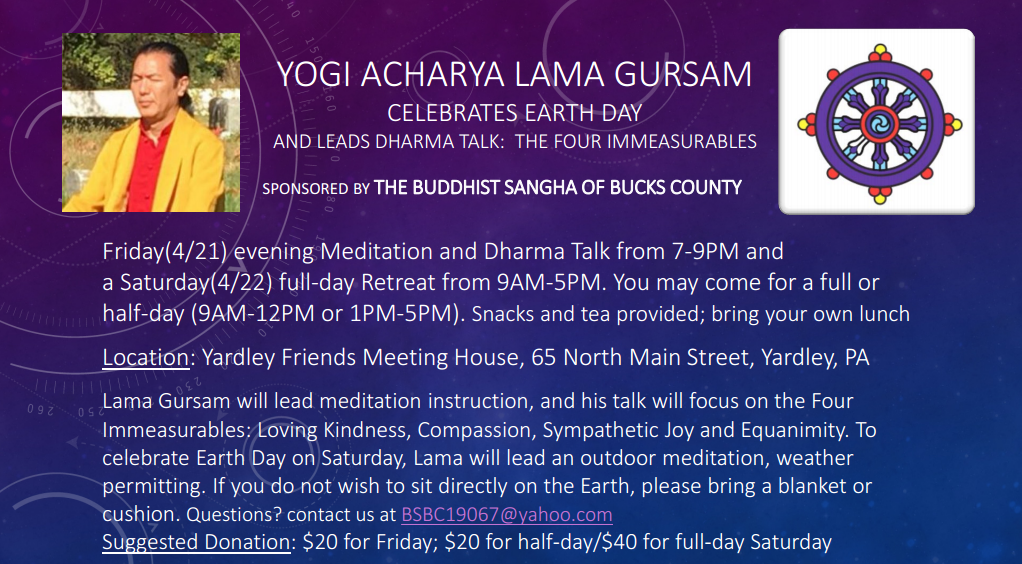
Lama Gursam April 21 and 22

Join the Buddhist Sangha on April 21 and 22 as we host our beloved visiting teacher Yogi Acharya Lama Gursam for a Friday evening Meditation and Dharma Talk from 7-9PM and a Saturday full-day Retreat from 9AM-5PM. You may come for a full or half-day (9AM-12PM or 1PM-5PM).

His talks on Friday will focus on the Four Immeasurables: Loving Kindness, Compassion, Sympathetic Joy and Equanimity.

To celebrate Earth Day on Saturday, Lama will lead an outdoor meditation Saturday, weather permitting. If you do not wish to sit directly on the Earth, please bring a blanket or cushion.

Location: Yardley Friends Meeting House / Buddhist Sangha of Bucks County
65 North Main Street, Yardley, PA 19067

Suggested Donation: $20 for Friday
$20 for half-day/$40 for full-day Saturday

Flyer can be downloaded here LamaGursam-April-2017

Posted in Home | Tagged , , , | Comments Off on Lama Gursam April 21 and 22

Timber Hawkeye Dharma Talk: “Pain Is Inevitable, Suffering is Optional” with a Q&A

We are very happy to announce that we will have Timber Hawkeye, who wrote two books: Buddhist Boot Camp and Faithfully Religionless, as our guest via SKYPE during our Discussion time (8-9PM) on April 10th, 2017.

All are welcome to join us for this unique, exciting experience.  In support, donations are welcome and appreciated. Thank you!

Timber Hawkeye, bestselling author of Buddhist Boot Camp and Faithfully Religionless, offers a secular and non-sectarian approach to being at peace with the world (both within and around us). His intention is to awaken, enlighten, enrich and inspire.

More information about Timber and his work  http://www.buddhistbootcamp.com/


Posted in Home | Tagged , , | Comments Off on Timber Hawkeye Dharma Talk: “Pain Is Inevitable, Suffering is Optional” with a Q&A